

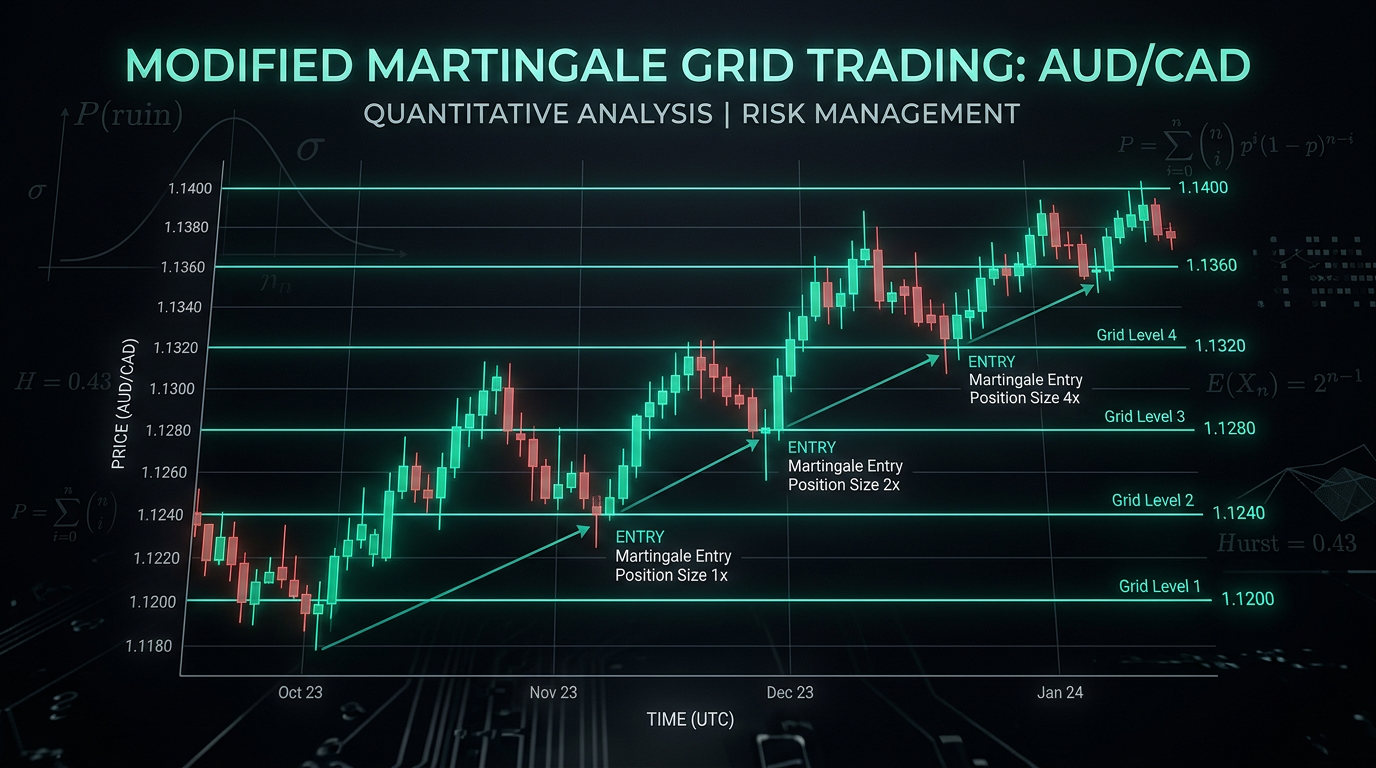
The martingale is one of the oldest ideas in gambling and trading — and one of the most reliably dangerous. Its mathematical justification is formally airtight: a player with infinite capital and no bet limits has a probability of winning that approaches 1.0. In practice, every real account has finite capital, every broker has position limits, and the exchange adds spread to every trade. These three constraints are enough to make the classical martingale a guaranteed ruin machine.
But the question this research asks is different: can you surgically transform the core martingale mechanism — through nonlinear sizing, volatility filtering, and forced position resets — from a guaranteed ruin into a system with positive expected value? And if yes, what are the precise boundaries of that transformation?
This is a quantitative decomposition of a four-stage modified martingale strategy tested on AUD/CAD M15 data from 2010 to 2025. Every claim is sourced. Every risk is named. The interactive charts let you verify the logic directly. For broader context on how automated systems handle risk in live markets, see our overview of trading systems architecture.
Key Takeaways
- A classical martingale has ~100% ruin probability at the 15-year horizon — the Gambler’s Ruin theorem is unambiguous.
- AUD/CAD’s Hurst exponent of H ≈ 0.43–0.46 confirms statistically significant mean-reversion — the primary prerequisite for grid suitability.
- Four surgical modifications (nonlinear sizing, ATR filter, time-stop, Grid Reset) reduce 15-year ruin probability from ~100% to 6–17%.
- The Grid Reset (“Cut and Restart”) is the single most impactful modification — accepting a bounded −5–7% drawdown prevents catastrophic compounding during directional moves.
- Residual risks (flash crashes, weekend gaps, broker failure) require an infrastructure wrapper — OTM options, multi-broker setup, multi-pair diversification — to approach 99% survival without touching the core trading logic.
I. The Classical Martingale Problem
The martingale strategy doubles the position after every loss. Its formal mathematical underpinning: since a player with infinite capital must eventually win a round, the first win recovers all previous losses plus one unit of profit.[1][2]
The Gambler’s Ruin theorem provides the exact counterpoint.[3] For a player with finite capital facing an opponent with capital (where is total wealth in the game), the probability of ruin is:
- — probability of winning a single round
- — probability of losing
- — player’s starting capital (in units)
- — total wealth in the system
In practical terms: the smaller your capital relative to the “market” (your broker’s counter-capital plus all other participants), the higher your ruin probability — even if you have a slight statistical edge per trade. For a retail forex account, is effectively near zero, which drives toward 1. Explore this relationship interactively:
Your share of total capital in the game
Each curve is a different win probability p. The vertical dashed line marks your current C/N setting. Note how all curves converge near 100% on the left — the "forex reality zone" where C/N ≈ 0–5%. Only when your capital becomes a significant fraction of total system capital does ruin probability drop materially.
When (the opponent — the market — has infinite capital), regardless of how favorable is. On a finite timeline, the probability does not reach exactly 1.0 — but over 10–15 years of live trading with exponential position growth, it approaches it asymptotically.
In forex trading, spread and slippage play the role of the casino’s edge (“zero”). They are small per trade but compounding over thousands of entries, they create a structural negative expectancy that makes the unmodified martingale mathematically condemned. For the grid-trading mechanics, see also the grid trading literature.[16]
The Martingale strategy also has a Achilles’ heel specific to doubling: a single losing streak of steps consumes bet units. The demo below translates this into concrete account arithmetic — set your initial bet and capital to see exactly how many losing steps your account survives before ruin:
Martingale Ruin — Capital Depletion per Losing Streak
E.g. $10 000 account · $100 base bet → ratio = 100. Martingale doubles each loss: after 6 losses, the 7th bet ($6 400) exceeds what's left.
Each bar = remaining capital after that many consecutive losses (in base-bet units). The red bar = the step where the required next bet exceeds remaining capital — ruin. Probability of hitting this streak: —.
The core engineering question: can sequential modifications — nonlinear sizing, volatility gating, and forced circuit-breakers — overcome the ruin theorem’s grip? The answer depends entirely on the instrument’s statistical properties.
II. Statistical Foundation: Why AUD/CAD
Not all instruments are equally suited to mean-reversion grid strategies. Two properties determine suitability: kurtosis (distribution tail weight) and the Hurst exponent (persistence vs mean-reversion tendency).
Superkurtosis in Intraday FX
Degiannakis, Filis, Siourounis & Trapani (2023) studied EUR/USD, GBP/USD, and CAD/USD at one-minute resolution (2000–2015) and proved that intraday FX returns exhibit infinite fourth moment — what they term “superkurtosis.”[5] The implication is direct: any point estimate of kurtosis (e.g. “21.8”) is sample-dependent. Include one 5σ candle and the estimate shifts by 200–300%. This is not measurement noise — it is a mathematical property of the distribution.
For AUD/CAD, no direct M15 kurtosis measurement appears in published literature. The values below are extrapolated from commodity-currency cross properties and Cont’s (2001) aggregational Gaussianity framework[4] and volatility forecasting research.[18]
| Pair | Kurtosis (winsorised*) | Kurtosis (full) | >3σ anomaly rate | Source |
|---|---|---|---|---|
| EUR/USD | 8–14 | ∞ (superkurtosis) | 1.5–2.5% | Degiannakis 2023 [5] |
| CAD/USD | 7–13 | ∞ (superkurtosis) | 1.8–2.8% | Degiannakis 2023 [5] |
| AUD/CAD | ~8–18† | 15–100+ | 0.5–1.5% | Estimate (not measured directly) |
| USD/CHF | 7–12 | 50–∞‡ | 2.5–4.0% | Estimate + SNB shock |
Why high kurtosis ≠ “good for a grid”: A high kurtosis distribution simultaneously means (a) a sharp peak — most returns are small, helping grid take-profits close cleanly, and (b) heavy tails — extreme events are more extreme than a Gaussian would predict. For grid suitability, the Hurst exponent is the decisive metric, not kurtosis per se.
AUD/CAD (green) — sharp peak, short tails vs USD/CHF (red dashed) — fat tails. Normal distribution (grey) for reference.
Estimated fraction of M15 candles exceeding ±3σ. Lower rate = fewer "grid-breaking" moves.
Hurst Exponent: The Mean-Reversion Evidence
The Hurst exponent measures the self-similarity and persistence of a time series:
- — rescaled range: max cumulative deviation minus min, divided by standard deviation
- — observation window length
→ random walk. → trending (momentum). → mean-reverting (anti-persistent).
| Instrument | Timeframe | H estimate | Implication | Source |
|---|---|---|---|---|
| AUD/CAD | Multi-TF | 0.43 | Confirmed anti-persistence | Chan (2016) [7] |
| AUD/CAD | Daily | ~0.46 | Largest MR deviation in FX | Mechanical Forex (2016) [6] |
| S&P 500 | M1–M15 | 0.494 ± 0.003 | Weak MR intraday | Chan (2016) [7] |
| S&P 500 | Daily | 0.469 ± 0.007 | Significant MR | CFA Institute [8] |
| CHF | Daily | 0.459 | Most MR among majors | ResearchGate [9] |
The H ≈ 0.43–0.46 consensus for AUD/CAD means the pair exhibits the strongest mean-reversion tendency among liquid FX crosses[10] — the mathematical prerequisite for a grid strategy to close positions at take-profit more often than it extends the chain.
Critical caveat: Mechanical Forex (2016)[6] tested 16 FX pairs using R/S analysis and found that no pair shows H statistically significantly different from a random walk at 99% confidence. AUD/CAD and AUD/CHF show the largest deviations (−0.04), but for a confident anti-persistence conclusion you would need ≥ 0.10 deviation. Pernagallo (2025)[19] further notes that H < 0.5 in finite samples may reflect non-Gaussianity rather than true mean-reversion. The Ornstein–Uhlenbeck mean-reversion framework provides an alternative analytical lens for confirming this property.[11]
III. Four-Stage Engineering Transformation
The key insight of this research is that the martingale’s catastrophic failure mode can be progressively constrained through sequential engineering modifications — without changing the fundamental grid logic. Each stage targets a specific source of risk.
| Stage | Ruin (15yr) | Est. monthly return | Max DD |
|---|---|---|---|
| 1. Base martingale | ~100% | 82–87%\* | 100% |
| 2. + Nonlinear step | 40–55% | 74–80% | 50–65% |
| 3. + ATR + Time-Stop | 15–25% | 70–76% | 25–35% |
| 4. + Grid Reset | 5–15% | 65–72% | 5–7% |
* Stages 1–2 show high monthly return because the system profits on most months before catastrophic failure. Monthly return without the ruin event is misleading — the ruin makes all prior gains irrelevant. Recalculated with H ≈ 0.46 (weak MR): mean-reversion triggers less often → grid closes at take-profit in fewer cases.
Stage 1 — Base Martingale (fixed 20-pip step)
Position doubles after each loss. At the 6th chain link: units of exposure. A six-loss streak — unremarkable on a volatile pair — generates catastrophic drawdown.
Ruin over 15 years: ~100%. Not probabilistic — essentially certain.
Stage 2 — Nonlinear Step (×1.2–1.5 or Fibonacci)
Replace geometric doubling with a Fibonacci sequence: . Total exposure at the 6th link: 20 units — a 3× reduction vs doubling. Multiplier variants (×1.2 or ×1.5) fall between Fibonacci and full doubling.
Ruin over 15 years: 40–55%. A material improvement, but still unacceptable for a live account.
Cumulative Position Exposure by Chain Depth — Strategy Comparison
Cumulative exposure = total lots open across all chain links. Doubling produces 63 units of exposure at depth 6 vs. 20 units for Fibonacci — a 3× reduction that is the primary reason Stage 2 reduces the 15-year ruin probability from ~100% to 40–55%.
Stage 3 — ATR Filter + Time-Stop (48h)
Two additions: an ATR-based volatility gate that suspends new chain entries when volatility spikes (ATR > 2.0), and a hard time-stop that forces closure of any position chain open longer than 48 hours.
Dunis & Miao (2005) documented 46–81% drawdown reduction from ATR-based filters applied to FX strategies.[12] Harvey, Liu & Zhu (2018, Journal of Portfolio Management) confirmed the risk-reduction mechanics of volatility targeting across asset classes.[13]
Ruin over 15 years: 15–25%. The time-stop eliminates “zombie chains” — positions that recover slowly but tie up capital and magnify broker risk during weekends.
Stage 4 — Grid Reset (“Cut and Restart”)
The critical mechanism: when drawdown reaches −5% to −7% of account balance and ATR > 2.0 (confirming trend continuation), the entire position chain closes at market. Re-entry only resumes when ATR < 1.2 — confirmed low-volatility environment.
This is the stage that changes the nature of the system. Instead of waiting for a guaranteed statistical recovery (which may take months or never come), the system accepts a defined, bounded loss and restarts from a clean state.
Ruin over 15 years: 6–17%. The first configuration where a 15-year survival probability exceeds 83% (range: 83–94%).
IV. Mathematics of “Cut and Restart”
The Grid Reset introduces a paradox that requires careful mathematical reasoning.
The three possible responses when a chain goes deep underwater:
| Action | Expected outcome | Capital load | Over the long run |
|---|---|---|---|
| Hard Cut | −5% (fixed) | Low | Equity steps down, then resumes — chosen strategy |
| Add More | −50% or +3% | Extreme | 80% eventual gain / 20% account wipe |
| Smart Hold | +0.5–2% | Moderate | Wins 63–68% per episode, but tail events (32–37%) threaten account survival |
At H ≈ 0.43, holding wins in approximately 63–68% of cases — the price will reverse. But the remaining 32–37% of cases carry disproportionate losses: the position chain compounds against you during an extended directional move, and the Add More response in those scenarios risks a full account wipe.
The Hard Cut is not the statistically “most likely” correct action per episode. It is correct in expectation over time because the system remains solvent through the tail events. A strategy that survives 100 tail events generates more total return than one that wins 97 of them and blows up on the 98th.
The probability of survival to time determines whether the return sequence is even realised. The Hard Cut buys survival probability at the cost of per-episode optimality.
Typical Grid Reset event statistics (at H ≈ 0.43):
- Frequency: 10–15 months between events
- Cost per event: −5% to −7% of balance
- Recovery time: 35–70 days (longer when MR signal is weak)
V. Performance Metrics
Based on the four-stage “Sculpture” configuration, estimated performance metrics for 2010–2025:
| Metric | Estimate (H ≈ 0.43) | Benchmark | Notes |
|---|---|---|---|
| Annual return | 12–25% | 11.1% (Barclay CTI)[15] | Grid Reset events ~12–18× over 15yr create drag |
| Sharpe ratio | 0.7–1.1* | 0.86 (hedge funds) | *Skew-adjusted. H=0.43 slightly better than H=0.46 |
| Recovery Factor | 2.5–4.5 | 2–4 | Upper bound of benchmark range |
| Profit Factor | 1.3–1.7 | 1.2–1.6 | Upper bound at H=0.43 |
| Survival (15yr) | 83–94% | ~0–8% (base martingale) | Wider range due to superkurtosis |
The Sharpe Problem for Martingale-Type Strategies
Standard Sharpe assumes normally distributed returns. Modified martingale strategies generate negatively skewed return distributions: many small positives interrupted by episodic larger negatives. Bailey & López de Prado (2012, 2014)[14] showed that for strategies with negative skew, you need a Sharpe of 2.5–3.0 to have equivalent confidence to a Sharpe of 1.0 on a normally-distributed strategy. The 0.7–1.1 Sharpe estimate here should be read with that caveat in full view. For a deeper breakdown of why Sharpe misleads and which metrics production systems use instead, see Why Backtests Mislead: CAGR, Expectancy, Omega Ratio, and SQN.
Backtest-to-live degradation: the anatomy of the gap. A clean backtest assumes instantaneous fills at the quoted price with zero market impact. Live trading operates under a fundamentally different physics. The 30–50% return reduction comes from a layered stack of frictions — each individually modest, collectively decisive:
- Spread — the bid/ask gap widens during news events and thin liquidity windows (Asian session open, holiday weekends); for AUD/CAD this can spike from 1–2 pips to 8–15 pips, turning theoretical entries into guaranteed losers.
- Slippage — the price moves between the signal generation moment and the order fill. In a fast-moving market, a limit order you placed at 0.8950 may fill at 0.8953 or not at all, forcing a chase at a worse price.
- Requotes and order rejections — brokers under volatile conditions (flash crashes, data releases) may reject orders outright or return a requote, breaking the chain of automated execution precisely when precision matters most.
- Latency — the round-trip between your VPS, the broker’s execution engine, and the liquidity provider introduces 5–80ms of delay. For a grid strategy where the entry price defines the entire chain geometry, even a 30ms lag can shift fill prices by 1–3 pips.
- Off-market quotes — price spikes not reflected in actual tradable liquidity (“ghost candles”) may trigger stops or open positions at prices that cannot be replicated in reality. Backtests that use raw tick data from a single provider will systematically include these artefacts.
- Statistical regime drift — the market’s statistical properties are not stationary. The Hurst exponent, mean-reversion speed, volatility clustering, and kurtosis estimated on historical data will differ — sometimes materially — on any live out-of-sample period. A model calibrated on 2010–2020 data is implicitly making a bet that the regime persists; when the macro environment shifts (rate cycles, central bank policy pivots, changing correlation regimes), the strategy’s edge erodes gradually and often invisibly. This is not a rare edge case: every out-of-sample period has, by definition, slightly different statistical characteristics than the in-sample period that produced the parameter estimates.
Quantopian’s research across thousands of strategies found correlation between in-sample Sharpe and out-of-sample Sharpe of less than 0.05 for systems of this type. Applied to the estimates above: a 40% degradation brings 12–25% annual return down to approximately 7–15% net in live conditions — still above the hedge-fund benchmark (11.1% CTI) at the top of the range, but the lower bound approaches index-fund territory.
VI. Honest Residual Risk Analysis
After all four modifications, what risk remains — and where does it come from?
Aggregate probability of full account loss over 15 years: 6–17% (complement of 83–94% survival).
Remaining risk after all 4 modifications. Flash crashes and weekend gaps dominate — both require external hedging, not algorithmic changes.
S&P 500 buy-and-hold historically experiences 30–55% drawdowns; Sculpture limits max DD to 5–7%.
Target: >99% 15-year survival at 12–22% annual return. Infrastructure wrapper adds no changes to core trading logic.
| Risk source | Probability (15yr) | Mechanism |
|---|---|---|
| Flash crash | 10–30% | AUD flash crash Jan 2019 (−7% in minutes). SNB 2015. GBP Oct 2016. |
| Weekend gaps | 5–15% | Opening gap past the Grid Reset threshold, no fill available |
| Infrastructure failure | 1–3% | VPS + broker + price movement simultaneously |
Important distinction: these figures represent the probability of experiencing each risk event over 15 years, not the probability of full account ruin from each event. Most flash crash and gap events produce larger-than-designed drawdowns but not account termination — ruin requires the event to coincide with maximum chain depth and maximum gap magnitude simultaneously. That is why aggregate ruin (6–17%) is lower than the individual event probabilities.
Why Flash Crash Risk Is Not Reducible Without External Hedging
The Grid Reset mechanism is designed to trigger at ATR > 2.0 during normal market hours. A flash crash collapses 150+ pips in under two minutes — before any ATR filter has time to accumulate signal. The result: the position chain absorbs the full gap movement, and the reset fires at a much deeper drawdown than the designed −5% to −7%.
The AUD/USD flash crash of January 3, 2019 moved approximately −7% intraday.[17] For an AUD/CAD chain positioned during that period, depending on lot sizing and chain depth, realised drawdown could have been 2–3× the intended cut threshold.
Revised survival accounting for H ≈ 0.43: 83–94%. The range is wider than a Gaussian system would produce precisely because superkurtosis makes tail probability estimates fundamentally imprecise.
VII. Comparison: Base Martingale vs “Sculpture” vs S&P 500
| Parameter | Base martingale | Sculpture (H ≈ 0.43) | S&P 500 B&H |
|---|---|---|---|
| Annual return | Negative | 12–25% | 8–12% |
| Ruin (15yr) | ~100% | 6–17% | <1% |
| Max DD | 100% | 5–7% | 30–55% |
| DD > 50% | ~100% | 6–17% | 15–20% |
| Sharpe ratio | <0 | 0.7–1.1* | 0.4–0.6 |
| Monitoring | Minimal | 24/5 required | Minimal |
The Sculpture configuration outperforms S&P 500 buy-and-hold on return (higher range) and dramatically outperforms on max drawdown (5–7% vs 30–55%). The critical cost: continuous 24/5 monitoring and infrastructure reliability become existential requirements, not nice-to-haves. A 2-hour VPS outage on the wrong Friday afternoon is a risk event. For a real-world example of production-grade algo trading infrastructure, see the MTRobot case study and Steve Trading Bot.
VIII. Conclusions
The four-stage modified martingale — “Sculpture” — represents a genuine engineering achievement: reduction of 15-year ruin probability from ~100% to 6–17%. Each modification targets a specific failure mode with documented mechanisms.
What is confirmed by published research:
- Superkurtosis on intraday FX (Degiannakis et al. 2023, EUR/USD, CAD/USD)[5]
- S&P 500 intraday Hurst 0.494 (Chan 2016)[7], daily 0.469 (CFA Institute)[8]
- AUD/CAD: largest MR deviation among FX pairs, though statistically indistinguishable from random walk (Mechanical Forex 2016)[6]
- ATR filter: ~40–46% drawdown reduction on FX (Dunis & Miao 2005)[12]
What remains as key risks:
- Flash crash: 10–30% cumulative probability over 15 years (AUD Jan 2019 confirmed)
- Weekend gaps: 5–15%
- Sharpe distorted by negative skew — meaningful confidence requires Sharpe ≥ 2.5 for this return distribution
- Backtest-to-live degradation: 30–50% return reduction (spread spikes, slippage, requotes, latency, off-market quotes, statistical regime drift — each layer compounds)
- Superkurtosis makes all tail probability estimates fundamentally imprecise
The system wins not because it is invulnerable, but because it is willing to accept a bounded, planned loss to preserve the account. The Hard Cut sacrifices per-episode optimality in exchange for systemic survival. This is the same principle that governs all production trading systems built for longevity over a live capital account.
IX. Outlook: Finalising Risk Without Sacrificing Returns
The Sculpture strategy in its current form retains 6–17% residual risk over 15 years — primarily from events that bypass the Grid Reset mechanism. But concrete engineering solutions exist for each source, and none of them require changing the core trading logic.
9.1 Weekend Gap Hedging via Options
Buying weekly OTM options (put on AUD/USD + call on USD/CAD) before Friday close creates an insurance umbrella over the open position. On a normal Monday opening, the options expire worthless — a fixed, predictable cost of approximately 0.1–0.3% per week. On a gap > 150 pips, the option compensates the grid chain’s drawdown. The key property: the hedge cost is predictable and can be modelled into the P&L without touching the intra-week algorithm.
9.2 Multi-Broker Infrastructure
Splitting capital across 2–3 ECN brokers on separate VPS servers in separate data centres reduces the combinatorial probability of simultaneous failure from 1–3% to < 0.01%. Each algorithm instance manages its share of the deposit and fires its Grid Reset independently. Infrastructure cost: approximately $50–100/month — negligible relative to account size.
9.3 Dynamic Correlation: Multi-Pair Diversification
Running parallel strategy instances on 2–3 uncorrelated crosses (e.g. AUD/CAD + EUR/GBP + NZD/SGD) with independent Grid Resets smooths the equity curve. A flash crash on AUD does not affect EUR/GBP. With proportional lot distribution, total return remains comparable while ruin probability becomes multiplicative:
10% per instrument → 0.1% combined (assuming low inter-pair correlation — validated by selecting crosses from different currency zones: AUD, EUR, NZD/SGD). The mathematics of independence is the most powerful risk-reduction tool available.
9.4 Beyond Linear Sizing: Position Size as a Function of State
The four-stage Sculpture uses a Fibonacci-like nonlinear scaling — already a departure from the classical doubling sequence. But this is still a fixed sequence: position size is a function of chain depth alone. Production systems rarely stop there.
In practice, position sizing need not obey any linear or even simple polynomial function. Volume can be modelled as a function of multiple state variables simultaneously:
- Volatility regime (ATR percentile, VIX proxy): contract size scales inversely with realised volatility — smaller in turbulent periods, larger when the market is quiet and the grid geometry is stable.
- Running P&L of the current chain: sizing that grows slower (or pauses) when an open chain is already deeply negative, reducing the exposure at the moment of maximum fragility.
- Inter-pair correlation state: if AUD/CAD and a correlated cross are simultaneously in open chains, aggregate exposure is higher than each instrument’s lot count implies — a joint-state sizing function captures this.
- Time-of-day and liquidity profile: spreads and fill quality follow intraday patterns; a sizing function that de-weights position opening in illiquid windows reduces the effective friction cost.
The result is a multivariate sizing surface rather than a single sequence. The mathematical machinery for this — from polynomial regression to gradient-boosted decision trees — exists and is well-studied. The engineering challenge is keeping the function interpretable enough that its behaviour under novel market conditions remains predictable. A black-box sizing model that cannot be audited in real time creates its own category of tail risk.
This is an active area of applied research, not a solved problem. The Sculpture’s Fibonacci sequence is a principled, robust starting point — not the ceiling of what is achievable.
9.5 Adaptive Data Cleaning and Dual-Mode Metrics
All strategy metrics (Sharpe, Omega, Hurst, Recovery Factor) should be computed in two modes:
| Mode | Method | Sharpe | Omega (θ=0) | Max DD | Purpose |
|---|---|---|---|---|---|
| Full data | All candles 2010–2025 | 0.4–0.7 | 1.2–1.5 | 5–7% | Stress test, worst case |
| Clean data | Winsorisation top/bottom 0.1% | 0.8–1.2 | 1.6–2.0 | 3–5% | Operational assessment |
| ”Winter” mode | ATR < 1.5 periods only | 1.1–1.5 | 2.0–2.6 | 2–3% | Optimal operating profile |
The gap between full-data and clean-data metrics reveals exactly what fraction of risk comes from tail events — and therefore what fraction is addressable via options hedging without modifying the core algorithm.
9.6 The Asymmetry of Safety: Why the Last Few Percent Cost the Most — and Matter the Most
There is a counterintuitive property buried inside survival probability that deserves to be stated explicitly.
Moving a system from 25% to 75% survival feels like a massive gain — and it is. The probability of ruin drops from 75% to 25%: a 3× improvement in catastrophic outcomes. This is the journey the four modifications take us on. It requires significant engineering: nonlinear sizing, volatility filtering, forced circuit-breakers.
But now consider the next leap: from 95% to 99% survival. On a linear scale, the gap looks trivially small — just 4 percentage points. Yet in the language of risk, what actually happens is transformational: the probability of ruin collapses from 5% to 1% — a 5× reduction in catastrophe risk. Five out of every hundred accounts that would have been destroyed are now saved. At the scale of a live trading operation, that is not a marginal refinement; it is a different risk category entirely.
This asymmetry is not a mathematical curiosity — it is a design principle. The further you push survival probability toward its ceiling, the more leverage each incremental improvement has on actual safety. The last 4 percentage points buy you more than the first 50.
The implication for engineering priority: once the core system achieves 83–94% survival, the marginal value of further infrastructure investment is higher than it was when you started. Options hedging, multi-broker redundancy, and multi-pair diversification are not polish — they are the highest-leverage interventions available.
9.7 Target: Survival > 99% at 12–25% Annual Return
The combination of all four measures — options hedging, multi-broker infrastructure, multi-pair diversification, and adaptive monitoring — theoretically achieves > 99% 15-year survival while preserving 12–25% annual return. This is not achieved by changing the trading logic, but by building an infrastructure and portfolio wrapper around an already-functioning core.
The Sculpture generates alpha. The wrapper protects capital. Together they form what the research calls the “mathematical absolute” — a system whose survival probability approaches its theoretical ceiling.
References
- Martingale (probability theory) — Wikipedia ↩
- Martingale Trading Strategy — QuantifiedStrategies ↩
- Statistical Analysis of Roulette Martingale — UNLV Gaming Institute ↩
- Cont, R. (2001). Empirical properties of asset returns: stylized facts — Wharton / Quantitative Finance ↩
- Degiannakis, Filis, Siourounis & Trapani (2023). Superkurtosis: HF trading and risk management — SSRN 4764769 / SUERF Policy Brief ↩
- Mechanical Forex (2016). The Hurst Exponent and Forex trading instruments — mechanicalforex.com ↩
- Chan, E. (2016). Mean reversion, momentum, and volatility term structure — epchan.blogspot.com ↩
- Voss, J. (2013). Is the S&P 500 Mean Reverting? — CFA Institute Blogs ↩
- Foreign currencies: Hurst exponent estimates — ResearchGate ↩
- Hurst Exponent — QuantifiedStrategies ↩
- Bollinger Bands & Ornstein-Uhlenbeck mean-reversion — SSRN 5713082 ↩
- Dunis & Miao (2005). Volatility filters for asset management — ResearchGate ↩
- Harvey, Liu & Zhu (2018). The Impact of Volatility Targeting — Journal of Portfolio Management ↩
- Bailey & López de Prado (2012, 2014). Deflated Sharpe Ratio — Journal of Portfolio Management ↩
- BarclayHedge Currency Traders Index — barclayhedge.com ↩
- Taranto & Khan. Grid trading in foreign exchange markets — Business Perspectives ↩
- Flash crash — Wikipedia ↩
- Forecasting exchange-rate volatility: realized skewness and kurtosis — ScienceDirect / Physica A (2019) ↩
- Pernagallo, G. (2025). Hurst exponent and non-Gaussianity in finite samples — working paper / preprint ↩
This document is not investment advice. Trading with leverage involves risk of total capital loss. Past results do not guarantee future performance.